

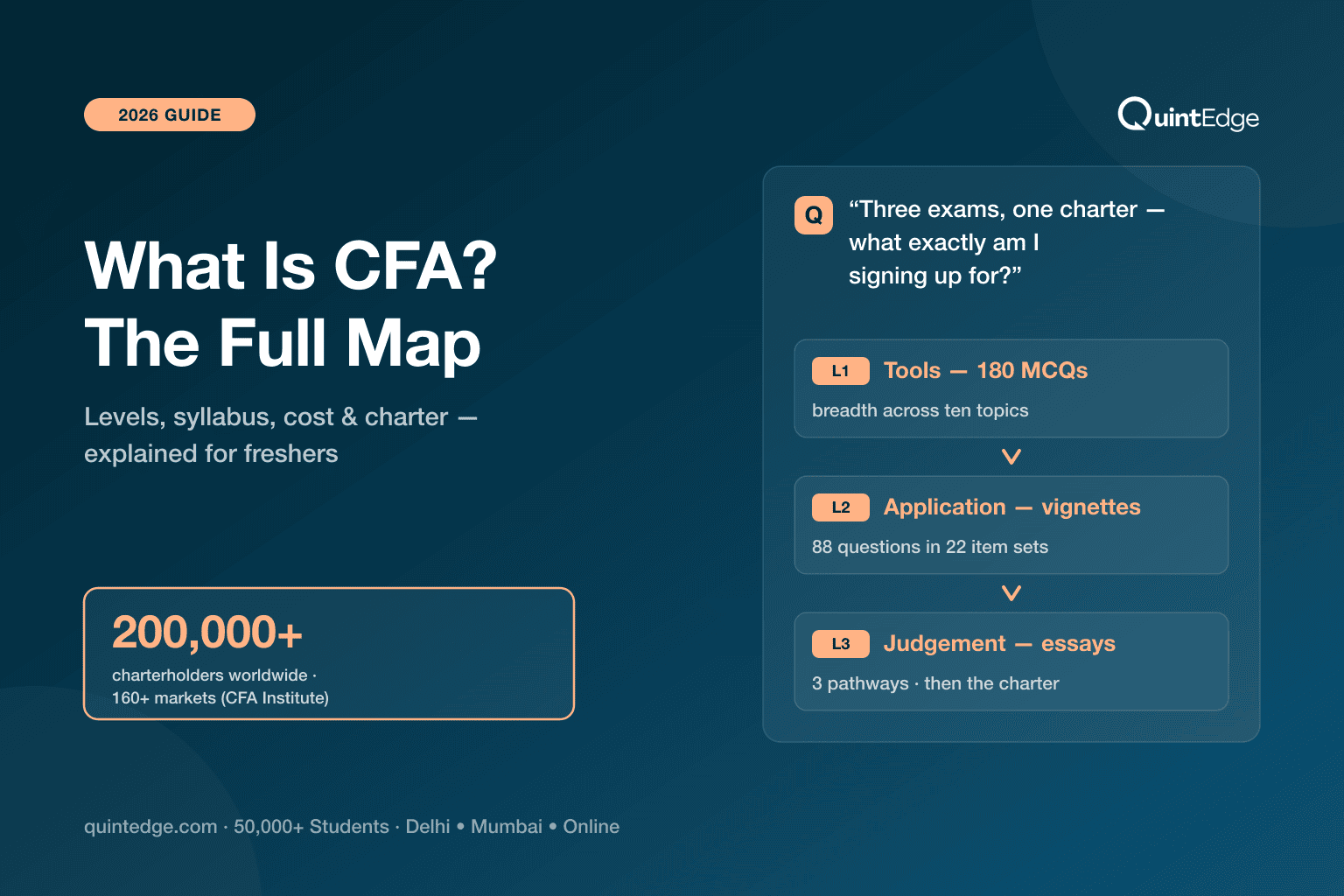
The CFA full form is three words: Chartered Financial Analyst. Most people searching for it already work in finance or plan to, and they want more than just the expansion of an acronym. They want to know what the credential actually covers, which subjects appear in the exams, and whether the curriculum matches the career they are building toward.
What Is the CFA Qualification?
The Chartered Financial Analyst designation comes from the CFA Institute, a global nonprofit body that has been running the program since 1963. In 2026, the charter is recognized by hiring managers across investment banks, asset management firms, and research houses in more than 160 countries.
Earning the CFA course requires two things: clearing all three exam levels and logging 4,000 hours of professional work experience in a relevant finance role. Neither requirement can be skipped, and the work experience does not have to come after the exams. Hours built before or during the program count toward the total.
The three levels are not simply harder versions of the same test. Level 1 builds a working base in financial reporting, economics, and investment fundamentals. Level 2 shifts to valuation, where candidates apply those concepts to actual company and asset scenarios. Level 3 moves into portfolio construction, wealth planning, and client focused decision making. Each stage demands a different kind of preparation, which is a big reason why the CFA course duration stretches well beyond what most candidates first expect.
What the CFA Degree Actually Tests
The CFA degree is built around ten subject areas. These areas run through all three exam levels, but the weight assigned to each topic shifts depending on the level. Level 1 tests foundational knowledge. Level 2 tests application through case based scenarios. Level 3 tests portfolio level judgment and client focused decision making.
The ten core subjects in the 2026 CFA curriculum are:
| Subject Area | What It Covers |
| Ethical and Professional Standards | Code of Ethics, Standards of Practice, GIPS |
| Quantitative Methods | Statistics, probability, regression, time value of money |
| Economics | Micro and macroeconomics, business cycles, currency markets |
| Financial Statement Analysis | Income statements, balance sheets, cash flow reports |
| Corporate Issuers | Capital structure, dividends, corporate governance |
| Equity Investments | Valuation models, industry analysis, market efficiency |
| Fixed Income | Bond pricing, yield measures, duration, credit risk |
| Derivatives | Options, futures, swaps, hedging strategies |
| Alternative Investments | Private equity, hedge funds, real assets, infrastructure |
| Portfolio Management | Asset allocation, risk management, behavioral finance |
The CFA degree does not test all ten subjects equally. The distribution of marks across these areas changes meaningfully from one level to the next, which directly affects how candidates should plan their preparation.
How Subject Weightings Shift Across the Three Levels
Knowing the weights attached to each subject helps candidates allocate study time properly. A topic worth 35 to 40 percent at Level 3 deserves far more preparation hours than one worth 6 percent at Level 1.
| Subject Area | Level 1 | Level 2 | Level 3 |
| Ethical and Professional Standards | 15 to 20% | 10 to 15% | 10 to 15% |
| Quantitative Methods | 6 to 9% | 5 to 10% | 0% |
| Economics | 6 to 9% | 5 to 10% | 5 to 10% |
| Financial Statement Analysis | 11 to 14% | 10 to 15% | 0% |
| Corporate Issuers | 6 to 9% | 5 to 10% | 0% |
| Equity Investments | 11 to 14% | 10 to 15% | 10 to 15% |
| Fixed Income | 11 to 14% | 10 to 15% | 15 to 20% |
| Derivatives | 5 to 8% | 5 to 10% | 5 to 10% |
| Alternative Investments | 7 to 10% | 5 to 10% | 5 to 10% |
| Portfolio Management | 8 to 12% | 10 to 15% | 35 to 40% |
Financial Statement Analysis disappears from Level 3 entirely. Quantitative Methods, which carries up to 9 percent at Level 1, has zero weight at the final level. Portfolio Management, on the other hand, accounts for up to 40 percent of Level 3. Candidates who treat all subjects equally across all three stages of the CFA degree misallocate their study time significantly.
How Each Level Approaches the Same Subjects
The same ten subjects return at every level, but how they are tested shifts completely at each stage.
Level 1
Multiple choice questions make up the entire paper at Level 1. The morning and afternoon sessions carry 90 questions each. Financial Statement Analysis and Ethics together account for nearly a third of the total marks. Candidates at this stage are building a working knowledge of finance fundamentals rather than applying them to real scenarios.
Level 2
Level 2 uses item sets, which are short case studies followed by four to six questions each. Every question ties back to a scenario, and pure memorization is not enough at this stage. Equity Investments, Fixed Income, and Derivatives carry the heaviest combined weight here. Valuation sits at the center of almost every case. This shift in format catches many candidates off guard after Level 1.
Level 3
The morning session at Level 3 includes constructed response questions requiring written answers, not option selection. Portfolio Management and Wealth Planning carry 35 to 40 percent of the total paper. Ethics at this stage tests judgment in realistic client situations rather than rule recall. The move from knowledge to applied judgment is what makes Level 3 the hardest adjustment for candidates who cleared the first two levels primarily through memorization and formula practice.
Careers Where the CFA Certification Carries Real Weight
The CFA carries the most value in roles where investment decision making is the core function of the job. In 2026, the positions most commonly held by CFA charterholders include:
- Portfolio Manager
- Equity Research Analyst
- Fixed Income Analyst
- Risk Manager
- Wealth Manager
- Investment Strategist
- Fund Manager
- Credit Analyst
In portfolio management and equity research, the CFA full form works almost as a baseline filter during hiring. Firms in these spaces actively look for candidates who have cleared multiple levels or already hold the charter. In commercial banking or general accounting roles, the credential carries less direct weight, and candidates should factor that into their decision before registering.
Conclusion
The CFA full form, Chartered Financial Analyst, is backed by a curriculum that runs ten subject areas across three progressively demanding exam levels. The CFA degree rewards candidates who study the right subjects with the right depth at each stage, not those who treat every topic as equally weighted throughout the program. Each level demands a different approach, and the subject weightings published by the CFA Institute make clear where to put the most hours at each stage. Zell Education supports CFA candidates through structured coaching programs built around the actual curriculum, so every candidate moves through the CFA degree with a clear direction at each level.
