

On the third floor of a 1960s block in Espoo, in a stairwell built before lifts were standard, stands an upright piano that has not left its corner in thirty years. It now has to come down a narrow staircase with two cramped half-landings. Four friends, the promise of pizza and a rented van sounds like the cheap solution — right up to the moment when 280 kilos of wood and cast iron starts to slide and nobody can stop it.
Piano moves fail not because people are weak but because the physics is unlike anything else in a home. An upright weighs 200–400 kg, a grand 300–600 kg, a concert grand more again, and the mass is not evenly spread: the centre of gravity sits high and the footprint is narrow, so the instrument tips forward far earlier than an amateur expects. Once it leans, muscle will not bring it back.
Know this at the quotation stage. Finnish carriers name their service-area pages after the city they cover, so for a move inside Espoo the page you want is the one titled Muutto Espoo rather than a national price list. The hourly rate quoted there covers ordinary household goods: boxes, sofas, wardrobes, beds. A piano is priced separately, and if you do not name it in the enquiry it is neither in the price nor necessarily inside the transport insurance.
What actually breaks in a piano
Damage falls into three categories, and only one is visible on the day. The first is the case: lacquer scratches on a threshold, corners chip, the lyre bends. The second is the action — thousands of moving parts, with hammer shanks and jacks of wood that does not tolerate impact. The third is the structure: string tension across the cast-iron frame runs to several tens of tonnes, and a hard knock can shift soundboard and bridge in a way you will not hear for weeks.
Some tuning drift happens in every move, even a perfect one; the difference is that afterwards the instrument needs a tuner, not a workshop.
The specialist kit is not marketing talk
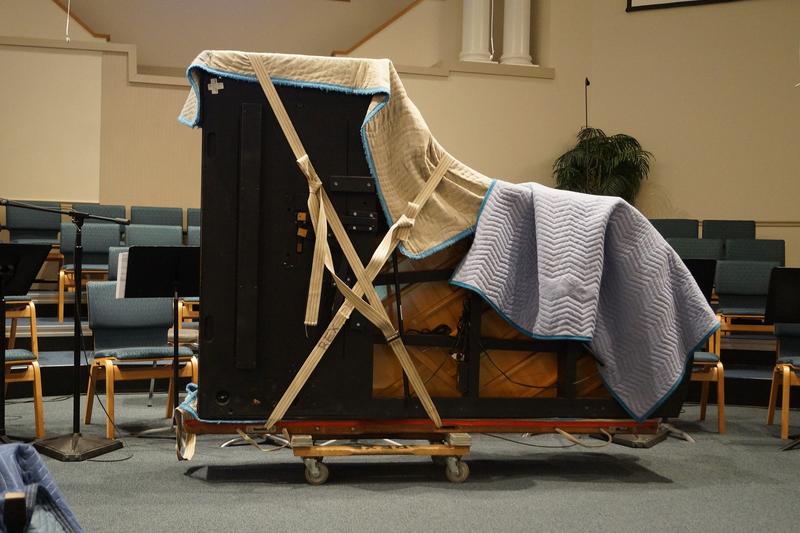
The real gap between a crew and four friends is equipment. A piano trolley — a low, wide-framed dolly — puts the weight on wheels so nobody carries the instrument for more than a moment, and broad straps with shoulder harnesses shift the load off the arms onto the body. A grand is always taken apart: legs and pedal lyre come off, and it travels on its side on a padded skid board. On stairs the crew uses a climbing track, or two people below and one above braking the descent, with a ramp over the steep sections.
In the van, what matters is the tail lift and the lashing rails: a piano must never travel loose, because one hard brake will put it over.
Stairs, lifts and the taloyhtiö
Measure the route before anyone touches the instrument. An upright is roughly 60–70 cm deep and 110–135 cm tall, so the obstacle is rarely a doorway — it is the turn in the hallway or the handrail on the landing. A lift helps, but not always: a typical residential lift is rated at around 400 kg, and piano, trolley and two movers reach that fast.
Tell the taloyhtiö (the housing company that owns the building) or the isännöitsijä (the property manager) in advance. In many Espoo buildings, booking the lift for moving day is routine, and covering the stairwell with cardboard saves the flooring and a later argument. In winter, gritting the yard belongs in the preparations.
Humidity, temperature and the days after
A piano is a wooden instrument, and wood moves with the air around it. The Finnish winter is harder on it than the journey: indoor relative humidity can fall to ten per cent, while the instrument wants roughly 40–60 per cent. Plan a sub-zero move so the piano spends as little time outdoors as possible, and let it stand untouched for a day on arrival. Brought from cold into warmth, it collects condensation on its metal parts, which the strings and tuning pins do not enjoy.
Choose the new position by temperature: above a radiator, beside a fireplace or in direct sunlight are all poor spots, and half a metre to one side can add months to a tuning.
Insurance and liability when something goes wrong
In a do-it-yourself move the damage is in practice your own loss: home insurance generally does not cover harm caused to an object while you are moving it, and a broken handrail is not, to an insurer, a sudden and unforeseen event. A firm carries carrier’s liability cover, but that has limits too — often a payout capped by weight, which can be lower than the owner imagines. Ask in writing what sum the piano is insured for, and whether the cover extends to the carry down the stairs or only to the drive.
Photograph the instrument beforehand from several angles, and if something is damaged, complain at once, in writing. Impartial guidance on consumer rights and disputes comes from the Finnish Competition and Consumer Authority.
What to ask before you book
- Do you have a piano trolley and skid board, and is dismantling a grand included?
- How many people are coming, and have they moved instruments before?
- What is the surcharge per floor without a lift?
- Up to what sum is the piano insured, and what is the excess?
- Who protects the stairwell, and who pays for damage to the structure?
- Is the quote in writing, and is it fixed or hourly?
Establish the order of magnitude at the same time. Moving an upright in the capital region usually lands between roughly 250 and 600 euros, a grand more, and a lift-free stairwell pushes the figure up floor by floor; ordinary moving help with two movers and a van runs at about 60–90 euros an hour. A breakdown of how pianonkuljetuksen hinta is put together is worth reading before comparing quotes, because the cheapest line on a price list says nothing about what the work contains. The labour portion may qualify for the kotitalousvähennys (the household tax credit), but the terms change yearly, so check what is in force on vero.fi.
What the owner does
Before the move: empty the music compartment and bench, clear the candlesticks and photographs off the top, lock the fallboard. Do not tape anything to a lacquered surface — the tape lifts the finish with it. Measure the route at both ends, book the lift, and warn the crew about thresholds and a steep yard.
Afterwards, be patient. Book the tuning for two to four weeks later, once the instrument has settled into the temperature and humidity of its new room. Before then it may sound strange for another reason: in a hard-surfaced new-build the same piano rings brighter than it did in a living room softened by rugs. Let your ears adjust before concluding that something broke. Usually nothing did — provided the move was done by someone who knew which way 280 kilos was about to lean.
