

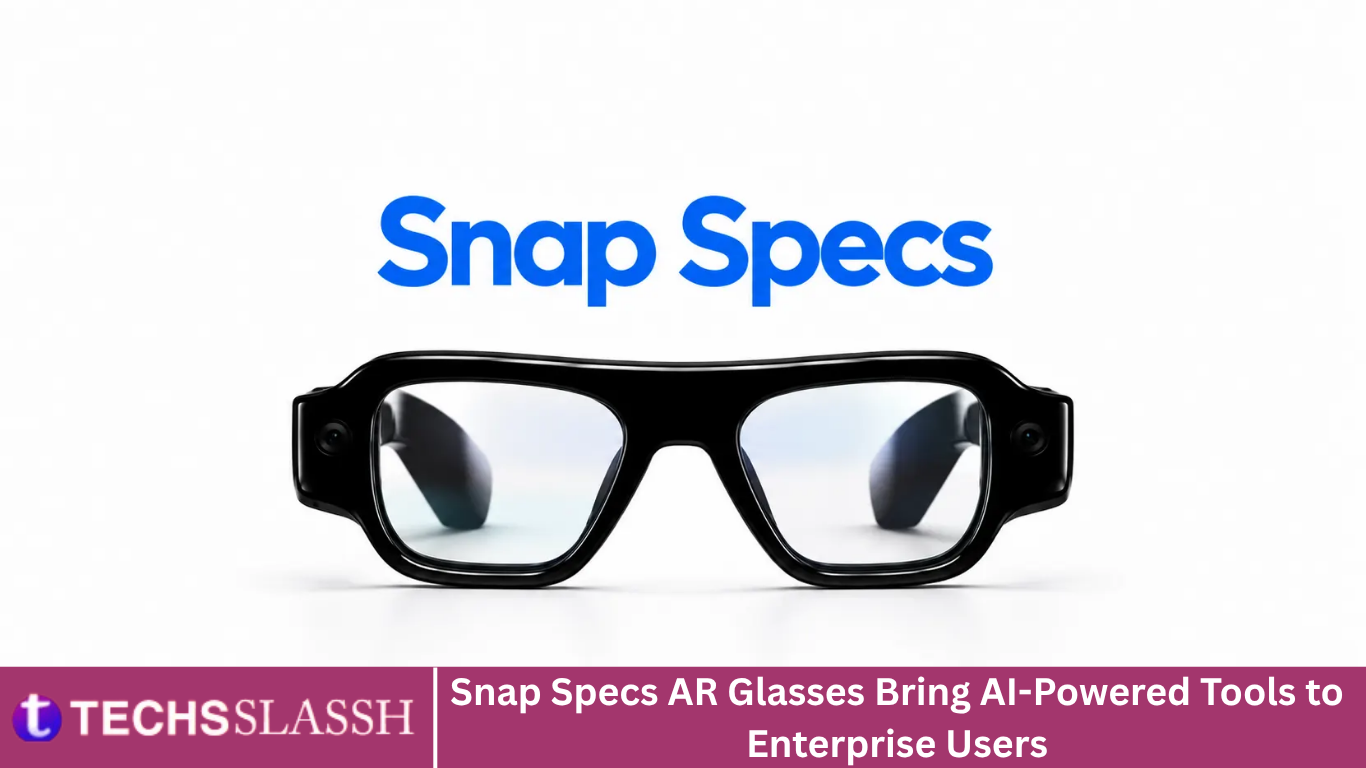
Snap is expanding the role of augmented reality glasses beyond entertainment and social media with new AI-powered tools designed for enterprise users. The company’s Specs platform is increasingly focused on practical workplace applications, giving employees access to hands-free information, assistance, and digital experiences.
The move highlights a broader shift in wearable technology. Instead of relying only on smartphones, tablets, or computers, workers can use smart glasses to interact with digital tools while keeping their hands available for physical tasks.
For businesses, this could be useful in industries where employees frequently need both hands for their jobs. Workers may be able to access instructions, identify objects, receive information, or communicate with other team members while continuing their physical tasks.
More Read: EU Proposes Social Media Age Restrictions for Children Under 13
What Are Snap Specs?
Snap Specs are augmented reality glasses developed by Snap, the company behind Snapchat. Unlike traditional glasses, AR glasses can overlay digital information and interactive experiences onto the user’s view of the physical world.
The technology is designed to combine real-world surroundings with digital content. This can make AR useful in situations where looking down at a phone or computer is inconvenient.
With AI becoming a major part of wearable technology, Specs can also serve as a hands-free interface for accessing information and completing certain tasks.
AI Comes to Enterprise Workflows
The addition of AI tools gives enterprise users new ways to interact with digital information. Employees can potentially use voice-based commands and visual information to receive assistance without interrupting their work.
This type of technology could be particularly relevant for:
- Manufacturing
- Retail
- Logistics
- Field services
- Healthcare
- Education and training
- Warehousing
- Customer support
The exact value depends on how companies integrate the technology into their existing systems and workflows.
Hands-Free Access to Information
One of the main advantages of AR glasses is the ability to access information without constantly reaching for another device. For example, a technician working on equipment could potentially view instructions through the glasses rather than stopping to check a manual on a phone or laptop.
Similarly, employees working in warehouses could potentially receive information while moving through a facility. This could reduce the need to repeatedly switch between physical tasks and digital devices.
AI can make this interaction more natural by allowing users to communicate through conversational commands instead of navigating complicated menus.
Visual AI Could Expand the Possibilities
AR glasses become more useful when AI can understand what the wearer is seeing. Computer vision and AI can help wearable devices interpret objects, surroundings, and visual information. In an enterprise environment, this could support tasks such as identifying equipment, locating products, or providing contextual information.
For training purposes, visual AI could also help employees understand procedures by connecting digital instructions with real-world objects.
However, these capabilities also require careful testing. AI-generated information needs to be accurate, particularly when employees use it during technical, industrial, or other professional tasks.
New Opportunities for Training
Enterprise training is another area where AR glasses could have an impact. Instead of learning entirely through videos or traditional manuals, employees could potentially receive instructions while performing a task. Digital guidance could appear alongside the real-world equipment or environment.
This could make training more interactive and allow employees to practice procedures in realistic settings.
Businesses could also use AR to provide remote assistance. An experienced worker or specialist could potentially help someone in another location while the employee wearing the glasses shares their view.
Why Businesses Are Interested in AR Glasses
Companies are increasingly exploring wearable technology because it can connect digital systems with physical work. Traditional enterprise software is often designed around screens. AR glasses introduce another possibility: bringing useful information directly into the employee’s field of view.
This can be especially valuable when workers cannot easily use a keyboard, mouse, or smartphone.
For businesses, potential benefits include:
- Hands-free access to information
- Interactive employee training
- Remote support
- Real-time guidance
- Visual data access
- New customer experiences
- Integration with AI assistants
The technology is still developing, so businesses must evaluate whether these benefits justify the cost and complexity of deployment.
Privacy and Security Remain Important
Enterprise use of smart glasses also raises questions about privacy and data security. Because cameras and microphones can be part of wearable devices, companies need clear policies around when recording or data collection is allowed.
This becomes particularly important in workplaces where employees interact with customers, confidential information, or sensitive equipment.
Businesses adopting AR glasses may therefore need to consider data storage, access permissions, employee privacy, customer consent, and security requirements.
Snap’s Broader AR Strategy
Snap has spent years developing augmented reality technology through Snapchat and its Lens ecosystem. Specs represent an extension of that work into wearable computing. The enterprise focus also reflects a larger industry trend.
Technology companies are exploring how AI assistants, computer vision, and wearable hardware can work together. Rather than treating AR glasses simply as another screen, companies are increasingly looking at them as interfaces between people, AI, and the physical environment.
The Future of AI-Powered Smart Glasses
The combination of AR and AI could eventually make smart glasses more useful across many professional environments.
Future devices could become better at understanding context, recognizing objects, translating information, providing instructions, and communicating with enterprise software.
However, widespread adoption will depend on several factors, including hardware comfort, battery life, AI accuracy, privacy protections, connectivity, pricing, and business integration.
Snap’s enterprise-focused Specs efforts show that AR glasses are being considered for more than consumer entertainment. The technology is moving toward practical workplace applications where AI can provide assistance without requiring employees to constantly look at a separate screen.
Frequently Asked Question
What are Snap Specs?
Snap Specs are augmented reality glasses developed by Snap. They are designed to combine digital experiences with the user’s real-world surroundings.
How can AI help enterprise users with AR glasses?
AI can provide hands-free assistance through conversational interactions, visual understanding, information retrieval, and task guidance.
Which industries could use AR glasses?
Potential applications include manufacturing, logistics, retail, healthcare, field services, education, and employee training.
Can AR glasses replace smartphones or computers?
AR glasses are unlikely to replace all traditional devices. Instead, they can provide an additional hands-free way to access information and digital tools.
Can businesses use AR glasses for employee training?
Yes. AR can provide interactive instructions and digital guidance while employees perform tasks in real-world environments.
Are there privacy concerns with smart glasses?
Yes. Cameras, microphones, and data collection can create privacy and security concerns, especially in workplaces. Businesses need appropriate policies and safeguards.
What is the future of AI-powered AR glasses?
Future AR glasses could offer more advanced visual understanding, AI assistance, translation, navigation, training, and enterprise software integration as the technology develops.
Conclusion
Snap Specs are part of a growing movement toward AI-powered wearable computing. By bringing AR and AI tools into enterprise environments, Snap is exploring how smart glasses can support workers with hands-free information, training, communication, and task assistance. The technology still faces challenges around privacy, reliability, cost, and workplace integration. However, as AI and AR continue to develop, smart glasses could become an important tool for businesses looking to connect digital assistance with real-world work.
